The competiton

In October we asked members of the public to submit their 'ultimate journey' on our Facebook page for a chance to win an Astra GTC for 3 months. The submissions were open to the public vote and with over 500 votes five lucky winners made it to the top. You can follow their progress as they review this incredible new model right here and on our Facebook Page.
Showing posts with label Vauxhall Factory. Show all posts

Monday, May 21

Spirit of Adventure: What does this button do?


The Astra GTC has a button on the end of the indicator-stalk that seems to serve no function.

I assume it has a purpose in one of the higher spec variants of the car, but in the example I have been driving, it seems to be redundant.  Whenever you see a plain plastic panel where there obviously should be a button or control of some kind, you are reminded that you are driving something at the lower end of the model's range. Which makes it all the more amazing that I should find this lower spec GTC such a fantastic car.  Things can only get better as you move up through the options and, with the top-of-the-range VXR model going into production, the Astra GTC range now reaches from “Good” to “Spectacular.”


Now that my time with the Astra GTC has come to an end, I can only look back with fondness and admiration.  Returning to Peter Vardy Vauxhall, in Perth, I took it on one last fling among the back roads of Central Scotland, cutting up through Torrance, and Kirkintilloch, taking the Kilsyth road to Haggs, before cruising up the M9 to Perth. Handing over the keys and walking away was a difficult moment. If I was in a position to buy it there and then, I would not have hesitated.
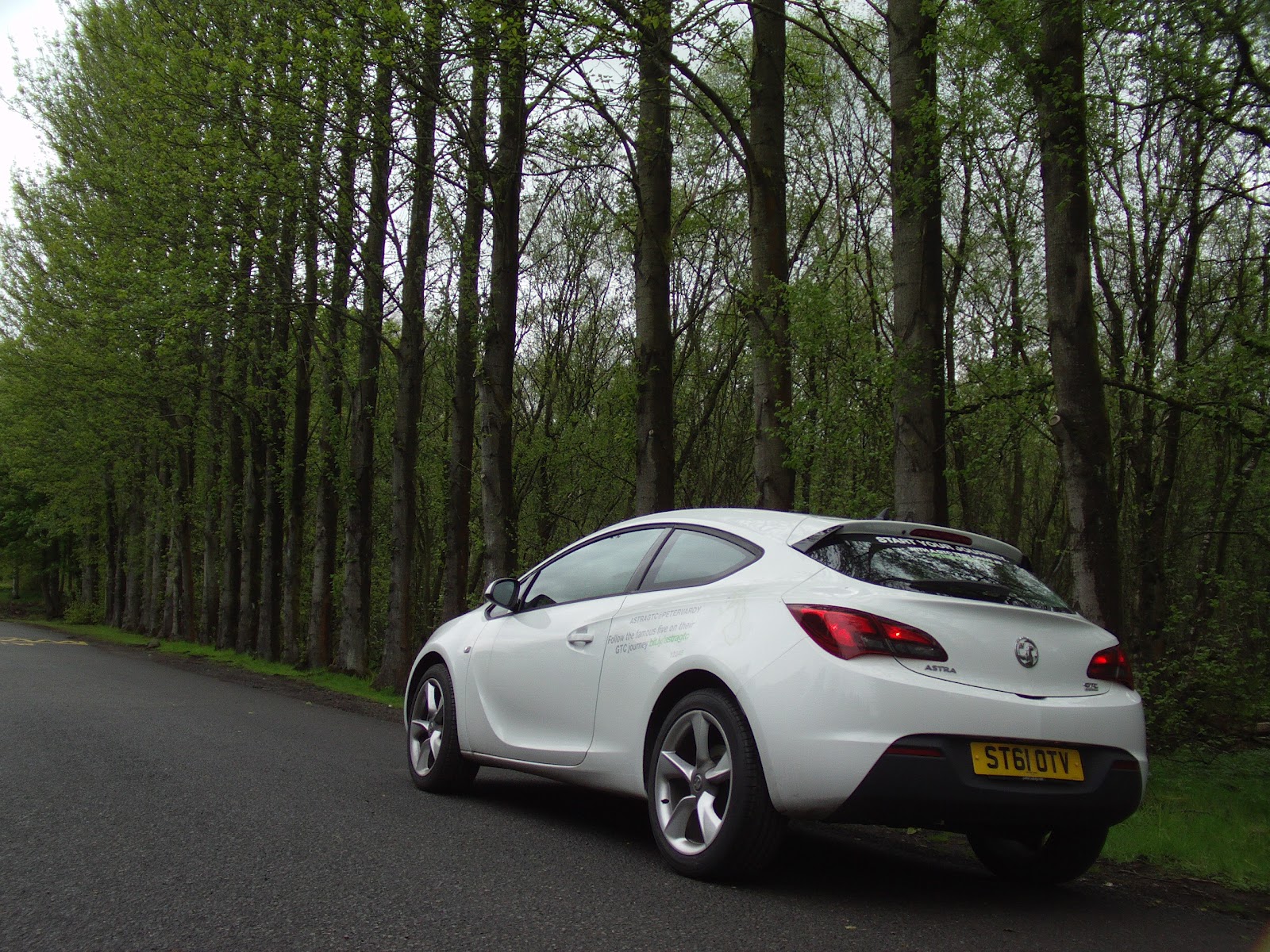

Vauxhall have done remarkable things with the GTC.  In fact, they have done pretty well with the Astra in general.  I was happy to hear, last week, that the Ellesmere Port plant has been given a huge boost by GM to keep production of the Astra going well into the future.

But the Astra isn't the only important model in Vauxhall's future.  Earlier this week, I paid a visit to the Peter Vardy Dealership in Edinburgh, where I was introduced to the amazing new Ampera.  I had seen this car, briefly, when I was down at the factory, but the good people at Peter Vardy were kind enough to let me take their demonstrator for a test drive.


Before I even mention the game-changing technology involved in this model, I have to say it's a very well finished, nicely designed car. It feels substantial and safe, and the EuroNCAP tests confirm that it is one of the safest cars on the road. The leather seats are the most comfortable I have ever sat in, and I've sat in many a comfy chair! The steering wheel is very similar to the one in my Astra GTC but, shaped in soft leather, it's far more comfortable. If this ergonomic steering wheel is available as an option in the GTC, I would definitely recommend it.

I was surprised that the Ampera was only a four-seater. The centre console reaches right through the cabin, similar to an option found in a Bentley or Rolls-Royce, providing two rear passengers with  cup-holders, extra storage, and a power socket at a convenient height.

The reason for this centre console is that the Ampera is driven by an Electric Motor which is powered by a huge battery pack, positioned through the middle of the car for the perfect centre of gravity. There are fleeting moments when you can sense the additional weight of the batteries but I found the car to be very well balanced, and when tackling some of my favourite roads it handled the twisty stuff fantastically. It's little wonder it has been named Car Of The Year 2012.


You may have heard people talk about “Range-Anxiety” when it comes to Electric Cars. This is something I experienced when I tried a small, “city” electric car, recently. I spent the entire time worrying about the state of charge, unable to enjoy the drive. The Vauxhall, on the other hand, has the ideal solution for this. They've engineered a small “back-up” generator into the system, fuelled by standard unleaded petrol, which can keep the electric motor powered for hundreds of additional miles if you let the battery charge go down.

In most cases, you can drive back and forth to work and go all the places you normally go in a car, running only on the electricity you put in at home. In theory, one tank of petrol could last for months or even years, as opposed to the couple of weeks any other petrol car lasts between £60 fill-ups. Even when I ran down the charge and used up all the fuel, as I did on my 100+ mile test drive, the Sat Nav automatically offered me the choice of the nearest filling stations. I thoroughly enjoyed the drive, with absolutely no concern about the possible range.


Driving the Ampera feels much like driving any other premium automatic car, but a little mind-set tweaking is required. It's only once you've driven an electric car, that you realise how much information you normally get from the sound of an engine. In the Ampera, the only noise is the wind and road noise, which above a certain speed is much the same as you'd experience in any other car. But at low speeds the car is exceptionally quiet.
"Almost too quiet."
The people at Vauxhall have recognised the concern that pedestrians may step onto the road, not realising the stealthy saloon is approaching. While most cars already have a device fitted to alert other road users of their presence (the Horn) Vauxhall have come up with a secondary alert which is far less aggressive, or alarming. The Ampera can give a discrete, but noticeable “Chirrup” sound to catch the attention of anyone who is clearly about to step out into your path.

How do you make this sound?

There's a button on the end of the indicator-stalk for that.

Friday, March 30

The Road Back to Scotland

After a nostalgic weekend in Warwick, finding my old car, and meeting up with some great friends, I thought I'd indulge another little trip down “Memory Lane” and visit the city where I studied a few years ago. Memory lane turned out to be a fantastic little back road from Haseley to Kenilworth, zigzagging around Warwickshire fields and farms, before stretching out into the long, arrow-straight A429, passing the illustrious University of Warwick and into the not-so-illustrious City of Coventry.

The city centre is, by any standards, a bit grim, but it was nice to be back in familiar surroundings. After a satisfying coffee and a slice of the best carrot & walnut cake in my old favourite café, “Brown's,” I got back into the Astra GTC for the next stage of my journey.

Brown's Café

I eventually managed to negotiate Coventry's fantastically complicated road system and after half an hour of wishing the good people at Peter Vardy Vauxhall had selected the Sat-Nav option for this car, I found the motorway and began powering northwards, up the M1.

The Astra GTC performs well on the motorway, but despite being among the fastest roads in the country they are still incredibly dull. Not a lot happened between Coventry and my overnight stop in the grand old City of York and I think even the car was thoroughly bored with the 70mph cruise.


So the following morning, I imposed a motorway ban! OK, there wasn't much motorway left to use, but the principle remained. The Astra GTC seemed quite happy with this decision too, as it got back to doing what it does best, through the Yorkshire Moors. I love the sound the car makes when I give it the beans. The turbo gives it the slightest of asthmatic wheezes when lifting off the gas, but it adds tremendous character to a tremendous car. The smile on my face was matched only by the smile on the car's grill as it bobbed and weaved through the land. The car feels totally planted and still, after 2000 miles of relentless punishment, it revels in the twisty stuff, with the clever new mechanical bits under the skin keeping the car level in the corners, when it really should be wallowing into a ditch at the side of the road.


The control you feel in this car is immense. I never once felt that gut-churning sensation that I had taken a bend too fast, yet I am pretty sure other cars would have struggled to cope with some of the corners at the speeds I was comfortable doing in this car. There is an obvious warning, then, with this car. It is hugely competent, and inspires a great deal of confidence, so you always have to be aware of the speeds you are doing. If I was driving something else, and found myself being overtaken by an Astra GTC, I wouldn't even try to keep up. It can do things other cars just can't.

All too soon I arrived at Darlington, and time for another coffee break As my road-atlas starts to fall apart (a sure sign that I'm on a good journey), I plan out a route to the A68. The road that will bring me to my final overnight stop, in Edinburgh.


This is a pretty impressive piece of road-building, albeit a very dangerous road. South of the Border, the road consists of impossibly long straights stretching out beyond the horizon, but continually rising and falling with some long steep climbs and descents, interspersed with small hidden dips and blind crests. The sensation is similar to a “Big Dipper” style fun-ride but it's easy to let the concentration slip when there are no corners for miles.

Further North, I made the final border crossing of my journey and I rolled back into Scotland where, immediately, the roads got interesting again. However, the Electronic Speed Limiter had to be deployed, as the roads in the Scottish Borders have (probably) the highest concentration of Speed Cameras in the country! On roads where I need to be fully focussed on the road ahead, watching out for deer, sheep and other motorists, it's good to be able to let the car worry about the speedometer. The Speed Limiter will even beep if I get onto a long steep hill where gravity starts to pull the car over the set limit, encouraging me to cover the brakes to avoid any unnecessary fines.

Scotland - England Border
It wasn't long before I reached the City of Edinburgh, and arrived at my accommodation. The following day I head across town for a fantastic lunch with two of the “Polar” Bears (The Sporting Bears in Scotland) who helped make my journey come together. From there I visited the Headquarters of CHAS – The Children's Hospice Association in Scotland.

Visiting CHAS
I had a fascinating chat with Kirsten, from the fundraising team at CHAS, about the two hospices they run, Rachel House in Kinross, and Robyn House in Balloch. They hold open days and guided tours throughout the year so people can come and see some of the fantastic work they do for families with children who have life-limiting conditions. On the CHAS website, Ewan Macgregor (no stranger to adventure, himself) explains what CHAS does:

CHAS Website

CHAS has received almost £20,000 from the Sporting Bears Motor Club. Much of this can be attributed to the fantastic Dream Rides events held throughout the year. If you own an interesting classic, or modern sports car, why not join the Sporting Bears and bring it along to one of these events, taking people out for a ride to raise money for great charities like CHAS. The annual membership fee for the club is just £20 a year, and this covers all the club's costs allowing every penny raised through events and tours to be directed to the children's charities.

Sporting Bears Website

Wednesday, March 14

The Spirit of Adventure, Glasgow to Ellesmere Port


Shortly after leaving Glasgow the Astra GTC claimed it's first (and hopefully last) casualty. A young deer leapt into my path just a little closer than the fantastic brakes, and my not-quite-so-fantastic reactions, could cope with. The animal seemed to have recovered quickly, as it had left the scene by the time I had found a safe place to turn around and check on the poor beast. It didn't leave empty handed though, as the impact had dislodged a small piece of cosmetic trim from the from my Astra GTC, which was, like the deer, nowhere to be found.


I carried on south from Newton Mearns, a little disheartened by both the accident, and the missing trim, and followed the old A77 down to the Ayrshire Coast. I found an ideally placed B&B by the Cairnryan ferry port, and spent a relaxing weekend on the banks of Loch Ryan.

On Monday morning it was an early start to get along the road to the new Stenaline terminal to cross over to Northern Ireland. The Coastal Road to the Giant's Causeway is a wonder in itself. It's well signposted, and even where this road was closed the diversion kept the Astra GTC in it's element. The car loves corners and Northern Ireland's coastline lends itself to one of the finest roads for a car like this. The steering is beautifully weighted, not as twitchy as some rivals, but still direct, allowing the driver to make relaxed, confident progress.

The Giant's Causeway is a remarkable place. The visitor centre is being renovated just now so care had to be taken where the roads have been strewn with gravel over-spilling from construction trucks. The 10 minute walk to the sight itself is well worth the trek to experience the sheer scale of one of the most incredible natural phenomenon in the world.

After spending longer than planned taking in the beauty and mystery of this amazing place, I eventually got back on the road and headed inland, hunting down the old Grand Prix circuit near the village of Dundrodd. This is a road circuit I first read about just a week or two before my journey began. Unbelievably, it is still used as a motorcycle Tourist-Trophy circuit but the only evidence of this is a few chequered corner kerb-stones and marshalling posts dotted around the route. Oh, and the Start-Finish Straight, complete with Grid, Grandstand, and Paddock.

Belfast itself was a fascinating city, albeit not an easy one to navigate. The landscape is dominated by the two enormous gantry cranes in the harbour, built for the Harland & Wolff Shipyards. Known as “Samson” and “Goliath”, they are very useful landmarks to help visitors to this city find their bearings. Growing up in Glasgow in the 80s and 90s I had a very specific pre-conception of Belfast, and to be honest, not a positive one. But I found it a charming, characterful city, well aware of it's turbulent past, rightly proud of how it has turned around, and looking forward to a fantastic vibrant future, building on the strengths of the united community.


Tuesday was another eye-opening day, as I ventured through the Scottish Borders at dawn and crossed into England. As the sun rose on a crisp morning I pulled off the motorway at Penrith for fuel and to give the car another wash (keeping a white car looking clean for more than a day is near impossible!). Just two minutes from the motorway, is Ullswater, and the first sign that I'm entering a whole new world. I have travelled the M6 many times over the years, but had no idea what I had been missing, just one road over to the west!

The Lake District is one of the most beautiful places in Britain, and the roads are scarcely believable! The road beside Ullswater Lake becomes the Kirkstone Pass, known as one of the highest passes in England. It turned out this was just the first in a series of mountain passes, and routes, each of which became higher, steeper, and tighter as I progressed. The Astra GTC would have it's work cut out in this landscape,


From the Kirstone Inn, at the summit of that first pass, I took a little road, known only as “The Struggle.” A very appropriate name, but the Astra GTC coped well here. The little 1.4litre engine makes a lovely throaty noise under acceleration and soon the hills were alive with the sound of movement as my wee car carved it's way through the fabulous scenery.

Shortly after the quaint little village of Ambleside, I found the sign I had been looking for - “The Wrynose Pass”. This was one of the most intense piece of driving I have ever experienced, and makes the Scottish Highlands seem positively flat by comparison. Barely breaching 15mph, I, and a few other intrepid (or lost) drivers inched our way over impossibly contoured roads which seemed to have been draped over the hillsides at random. On roads like these, complete strangers sharing the same road begin to build a genuine kinship, and never has the phrase “We're all in this together” felt so appropriate.

The Astra GTC remained confidence-inspiring. At times I wondered if the relatively large turning circle would be able to cope with such extreme roads, but it proved no problem, as it blended tight left, steep dip, sweeping right, and over the crest, over and over again, for the best part of an hour. Yet as far as the roads were concerned the best part was yet to come.


To reach Eskdale, from Ambleside, you have to take a route known as the Hardknott Pass. This was the first time the Astra GTC began to struggle. Not with handling, or, steering, or even it's clutch, which was being put through one of the most extreme trials it could face. But the steepness of the hills seemed to interfere with the flow of fuel into or around the engine. I'm no mechanic, but that is certainly what it felt like to me. The tight, steep hairpins are just relentless on the Hardknott pass, and with speeds down to single figures much of the way, it felt like there was a real danger of being at the wrong angle for too long. Breaking down out here would be a massive problem, as these roads are just not suitable for recovery trucks, or even being towed by another car.

After a white-knuckle half-hour the Astra GTC made it to the summit, and just as slowly, edged it's way down the other side to Eskdale.  I don't think there is a steeper road in England than the Hardknott Pass, and I've got to give the little car a lot of credit for the competent way it handled the challenging route.

As a treat, in the afternoon, I took the little car through the Trough of Bowland in Lancashire, a great, scenic route, between Lancaster and Clitheroe, to let it get back into the spirited driving it feels most comfortable with.

As I arrived in Preston, my overnight stop, I just had time to stop in at the local Vauxhall Dealership, and ask if they could help me find a replacement part for the front of the car. As the GTC is so new, they didn't have any spare parts to hand, but the quick thinking Parts Manager  went out of his way to help me. He let me pop the piece of trim from the front of their Showroom Model and clip it onto my own car! At last my wee car was complete again, and was ready for the busy day it faced on Wednesday.
  
On this Journey, I am hoping to raise awareness of the fantastic work of the Sporting Bears Motor Club. Http://www.sportingbears.org.uk. On Wednesday Morning I paid a visit to Derian House, one of the Children's Hospices supported by the Bears, through motoring, and social events. So far the Bears have raised well over £10,000 for Derian House, enabling them to develop a new extension to continue caring for the children who live into young adulthood. Derian House can now provide respite care for children and young adults up to the age of 25, continuing the wonderful support they have been providing families who have a child with a life threatening illness. The hospice relies entirely on donations and you can contribute directly via http://www.justgiving.com/derianhouse.


On the Wednesday Afternoon, I took to the motorway and headed south to Ellesmere Port, and the Vauxhall Factory. (Read my blog post of the factory tour). In my next blog, I'll be writing about my Awe-inspiring drive through Wales, and you can find out if I made it to the Top Gear Track!

Friday, March 9

Vauxhall Factory Visit at Ellesmere Port

On Wednesday, I took a break from the B-roads and travelled down the motorway from Lancashire for about an hour. Just off Junction 7 of the M53, along a little back road, on the site of an old RAF base, you will come across the vast industrial units, and offices, which make up the Vauxhall Motors Factory at Ellesmere port.

When the good people at Peter Vardy heard I would be passing by that way, they managed to pull some strings and arrange for me to take a tour of the place where The Vauxhall Astra is born. A rare opportunity and privilege as such tours are normally booked up months in advance!

After a Health and Safety briefing, and introductory lecture (over tasty buffet nibbles), I donned my Hi-viz Safety Vest and Goggles and, along with a few other guests, headed for the factory floor, firstly to the “Body Shop,” and then to “General Assembly.”

The first thing you notice about the body-shop is how dark it is, yet at the same time it seems alive with movement. This is where the main parts of the body are pressed, welded and prepared for the assembly shop. At first, the parts being manoeuvred are just abstract pieces of metal, but as we progress through the tour the passenger cells start to take shape, and it soon becomes possible to identify the models being produced.


Although each part has been designed to have no sharp edges for the safety of those who have to handle them, a huge amount of the construction is carried out by an army of robots. Watching these machines in action is a mesmerising spectacle. They move with such finesse and rhythm that they each take on a character and charm of there own, performing their jobs tirelessly, and with flair. The darkness is necessary to avoid too much light interfering with the thousands of sensors required to make these fantastically dexterous arms do their thing. If you have ever watched an authentic Pizza Chef in action, or a cocktail bartender putting on a show you will know what I mean - these robots are just as fascinating to watch. I never thought about it before, but there is even a robot to fit the spare tire into place!

Vauxhall now operates what is known as a Build-to-Order, Just-In-Time Management system. In the old days it was common for a car company to guess how many cars it might sell, build that number of cars, and then try to sell them. This left airfields full of thousands of unsold cars as the companies in question slowly went out of business.  The Built-to-Order system which Vauxhall uses means they will only build a car once it has already been ordered so every single car produced has a home to go to when it rolls out of the assembly shop. Many of the panels such as doors, and electronics will be produced by outside suppliers and shipped to the factory by trucks. These panels have to arrive exactly at the right time (Just-in-Time), and in the right order so the assembly process can continue smoothly as the cars literally come together inside the General Assembly factory.

Every car on the line is different. The vast majority were Left-Hand Drive “Opel” models destined for European delivery, but the colours and body styles varied all along the line. Even the “last generation” style Astra van was being produced along side the current model SportsTourer (Estate) and Hatchbacks, demonstrating how versatile the line is.

At the end of the tour we made our way back to Hooton House, the main administration building on the site. On the way, we passed a section of the old airfield used to park up finished cars ready to be shipped. As far as they eye could see, Vauxhall Astras in their thousands were lined up waiting for the trucks to take them to their new homes. Our hosts commented that they hadn't seen that area as full as it was on Wednesday. Bearing in mind that every single car there corresponded to a specific order, it seems Vauxhall are going to do extremely well with the new Astra.
Parked next to the new electric hybrid Ampera, charging outside the Ellesmere Port Factory.